



The Physical Review Workshops focus on topics that straddle traditional subject boundaries and new ones that are starting to “emerge from the noise”. They are being developed as the expanded versions of the Physics Next Workshops. Since its launching in 2017, all the Physics Next Workshops had taken place in scenic Eastern Long Island, not far from the location of the APS editorial offices. The Physical Review Workshops would be held far away from Long Island, but would still be well attended by the relevant Physical Review editors. The present workshop is a follow-up to the first and second Physical Review Workshops outside the United States, both held in Hefei, China, on “New Frontiers of Superconductivity” (November 10-13, 2019; https://icqd.ustc.edu.cn/prworkshop) and “Quantum Materials for Modern Magnetism & Spintronics (Q3MS)” (July 11-14, 2021; https://icqd.ustc.edu.cn/prworkshop2021), respectively. Collectively, the goal of these workshops is to provide a setting to promote open and informal discussions and the exchange of information needed to help assess the promise and challenges of an emerging field. With this in mind, the workshops comprise only a limited number of presentations and leave considerable room for informal conversations, round-table discussions, and social activities.
IAS-APS Physical Review Workshop on Frontiers in Quantum Geometry and Correlation aims to bring together leading researchers and Physical Review editors from around the globe to present and discuss frontier topics in condensed matter physics. Key areas of focus include, but are not limited to, quantum geometric effects, novel magnetism, unconventional superconductivity, and nonlinear and nonreciprocal responses. The experimental platforms under discussion will feature graphene- and transition metal dichalcogenide (TMD)-based moiré materials, flat-band systems, few-layer rhombohedral graphene, novel antiferromagnetic materials, and kagome compounds. By bringing together diverse expertise, this workshop aims to foster vibrant scientific dialogue, cultivate long-term international collaborations, and accelerate discovery in this rapidly evolving field.
Group Photo
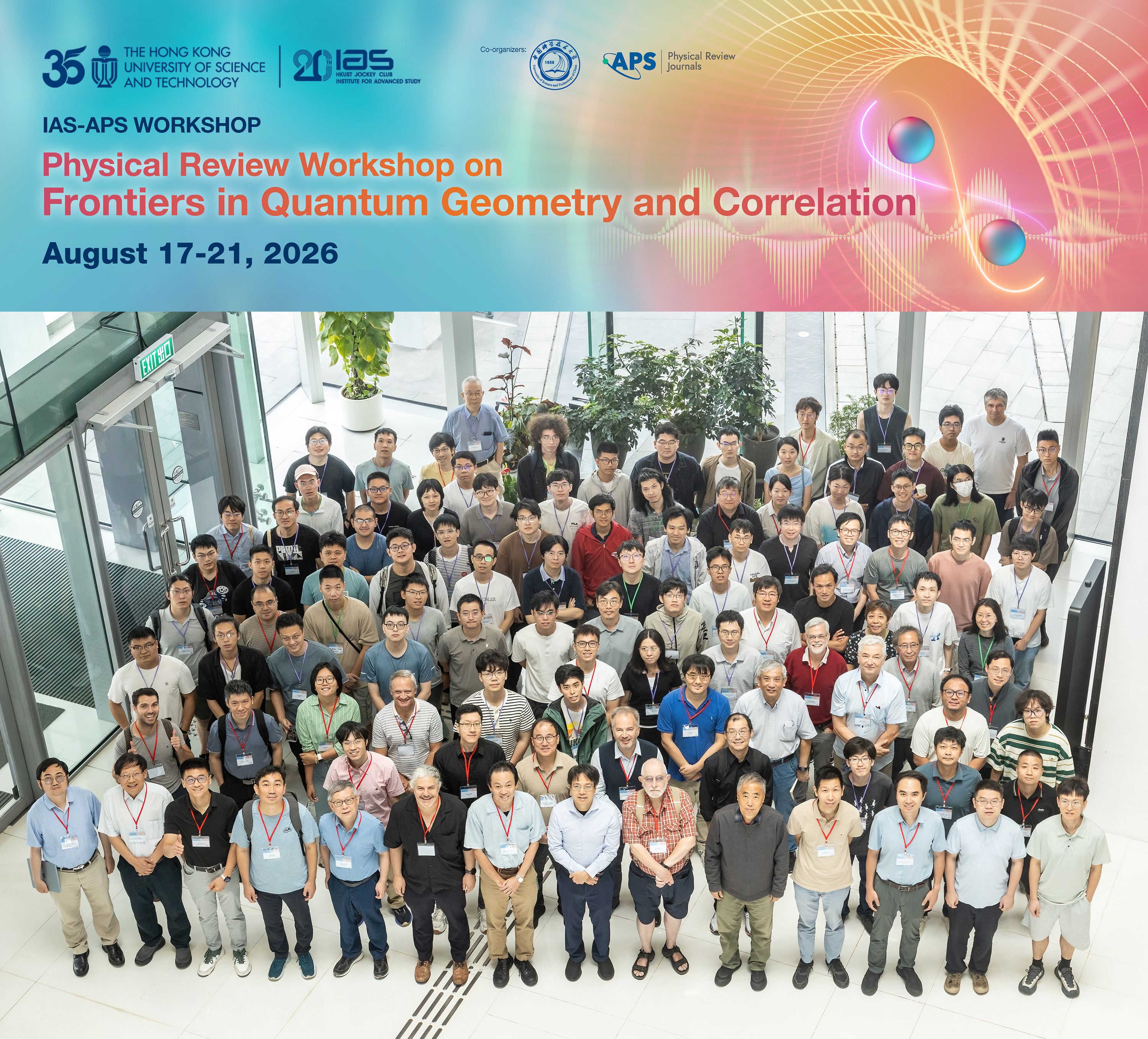
Organizers and the participants gather for a group photo.

American Physical Society - Physical Review Journals
University of Science and Technology of China
The Workshop is partly supported by Areas of Excellence Scheme (Project No.: AoE/P-604/25-R) from the Research Grants Council, HKSAR and New Cornerstone Science Foundation.